
The Real Difference Between Glasses and Hearing Aids: Seeing vs. Hearing Solutions
You’ve probably heard someone say, “Hearing aids are just like glasses for your ears.” While this comparison sounds simple and reassuring, it’s actually quite misleading. The reality is that glasses and hearing aids work in fundamentally different ways, address different types of problems, and provide vastly different results. Understanding these distinctions can help you set realistic expectations and make informed decisions about your hearing health.
The Root of the Problem: Mechanical vs. Neurological
The most significant difference between vision and hearing correction lies in what each condition actually involves. Most vision problems are mechanical – think of your eye like a camera that needs focus adjustment. When you’re nearsighted or farsighted, the issue is typically that your eye’s lens isn’t bending light correctly to hit the right spot on your retina. It’s essentially a focusing problem that glasses can fix by providing the right lens power.
Hearing loss, however, is usually neurological. Over 90% of hearing loss cases involve damage to the tiny sensory hair cells in your inner ear or problems with the auditory nerve pathways to your brain. Unlike vision problems, where your brain’s visual processing remains intact, hearing loss often means the very system that converts sound waves into brain signals is compromised.
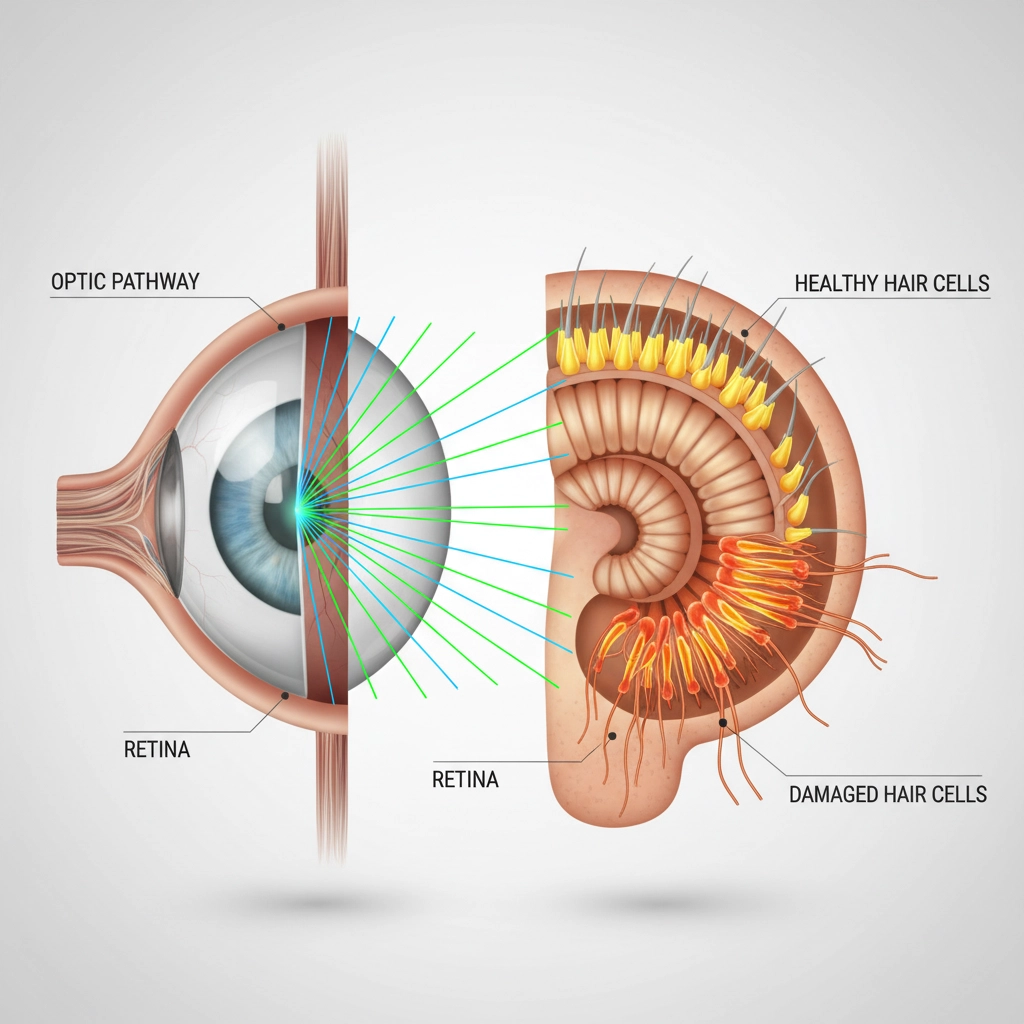
Think of it this way: if your eye is like a camera with a focusing problem, your brain is still a perfectly good computer ready to process the image once it’s clear. But with hearing loss, it’s like having both a damaged microphone AND a computer that’s forgotten how to interpret certain sounds.
What Each Device Can Actually Restore
Here’s where the “glasses for your ears” comparison really breaks down. Glasses can often restore your vision to 20/20 – essentially giving you back the eyesight you had when you were younger. Put on the right prescription, and you can immediately see clearly, read street signs, and watch movies without strain.
Hearing aids cannot fully restore hearing in the same way. They work by making sounds louder and clearer, but they can’t repair the damaged hair cells or restore your auditory system to its original state. You will definitely hear better with hearing aids, but it won’t be exactly like your hearing was before the loss occurred.
For example, someone with corrected vision can easily read tiny print or see details across a room. Someone with hearing aids might still struggle with certain situations – like following conversations in noisy restaurants or hearing soft consonant sounds clearly – even with properly fitted devices.
The Complexity Factor
The engineering inside these devices tells another part of the story. Glasses perform one primary function: they refract light at the correct angle and power to improve focus. Even progressive lenses or bifocals follow relatively straightforward optical principles.
Hearing aids are sophisticated computers that must perform multiple complex tasks simultaneously. They need to:
- Amplify different frequencies by different amounts
- Distinguish speech from background noise
- Process sounds in real-time without delay
- Adjust automatically to different environments
- Coordinate between two ears for directional hearing
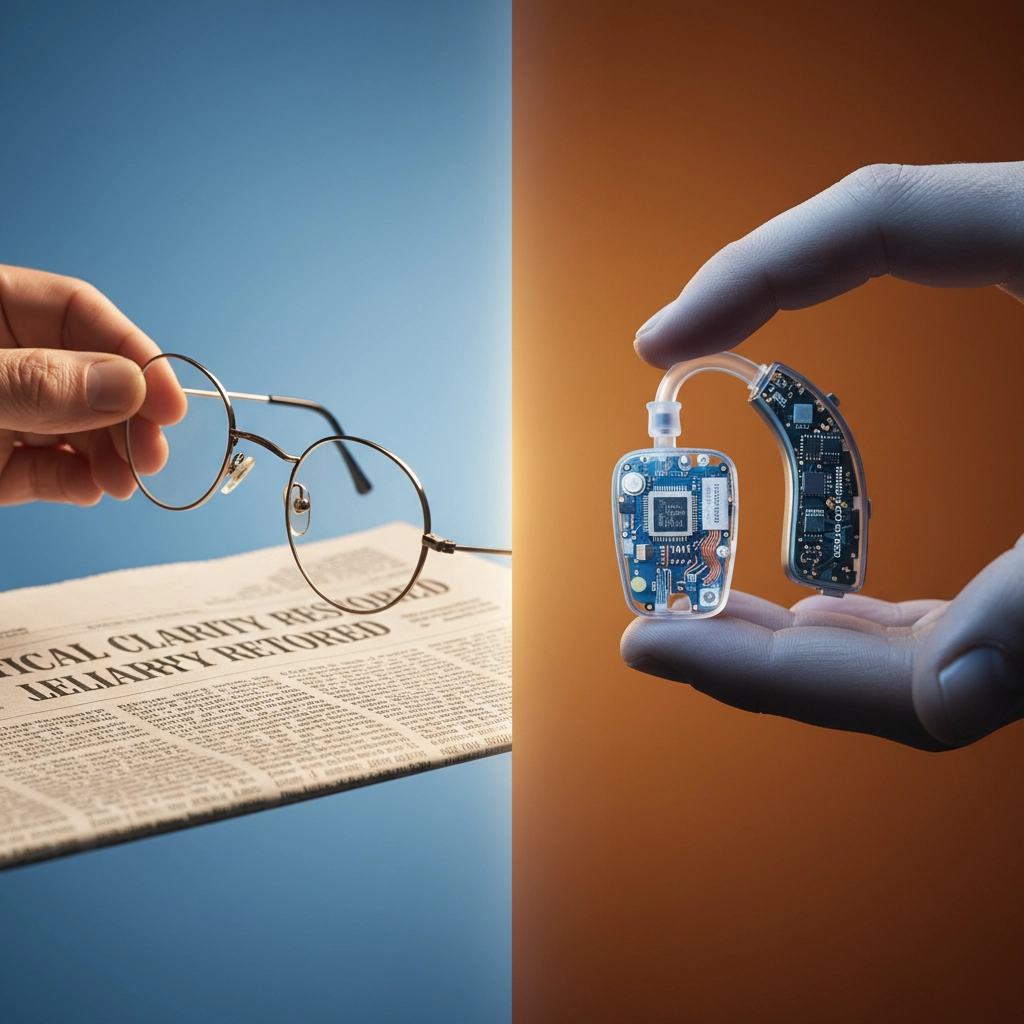
Modern hearing aids contain processors more powerful than the computers that sent humans to the moon, all packed into a device smaller than your thumb.
The Adjustment Journey
Getting glasses is usually straightforward. You get an eye exam, receive a prescription, pick up your glasses, and see clearly almost immediately. There might be a brief adjustment period for new progressive lenses, but most people adapt within days.
Hearing aids require a much more involved process. Your audiologist will typically need several appointments to:
- Program the devices to your specific hearing loss pattern
- Make adjustments based on your real-world experiences
- Help you gradually increase wearing time
- Fine-tune settings for different environments
The adjustment period can take weeks or even months. Your brain needs time to relearn how to process amplified sounds, filter background noise, and focus on speech. The longer you’ve waited to address your hearing loss, the longer this readjustment period typically takes.
How Your Brain Responds
Here’s a fascinating difference: wearing glasses can actually make your eye muscles weaker over time. When glasses do the focusing work, your eye muscles don’t have to work as hard, which can contribute to changes in your prescription.
Hearing aids have the opposite effect. By stimulating the auditory nerves and providing your brain with sound input, they help maintain and even improve your brain’s ability to process sound. This is why audiologists often emphasize that earlier intervention leads to better outcomes – the sooner you start wearing hearing aids, the better your brain maintains its sound-processing abilities.

The Social Perception Gap
The social acceptance of these devices couldn’t be more different. Glasses have become fashion accessories – people wear non-prescription frames just for style. About 64% of American adults wear prescription eyeglasses, and many view them as enhancing their appearance or suggesting intelligence.
Hearing aids, unfortunately, still face stigma. Despite the fact that about 29 million American adults could benefit from hearing aids, only about 20% actually wear them. Many people associate hearing aids with aging or disability, even though hearing loss affects people of all ages and often results from noise exposure rather than aging alone.
Why the Comparison Matters
At Northeast Occupational Audiology Associates, we often encounter people who expect hearing aids to work “just like glasses.” This comparison can set unrealistic expectations and lead to disappointment. When someone understands the real differences, they’re better prepared for:
- The initial adjustment period
- The importance of regular follow-up appointments
- Why hearing aids require more sophisticated technology
- How proper expectations lead to better satisfaction
Setting Realistic Expectations
Understanding these differences helps you approach hearing treatment with appropriate expectations. Unlike glasses, which provide immediate results, hearing aids are part of a comprehensive hearing healthcare journey that includes:
Professional assessment and fitting – Your audiologist will conduct thorough testing to understand your specific type and degree of hearing loss, then program devices accordingly.
Gradual adaptation – Most successful hearing aid users start by wearing their devices for short periods and gradually increase usage as their brain adapts.
Ongoing adjustments – Unlike glasses, hearing aids typically require periodic fine-tuning based on your experiences in different listening environments.
Lifestyle integration – Learning to use hearing aids effectively in various situations – from quiet conversations to busy restaurants – takes practice and patience.
The Bottom Line
While both glasses and hearing aids are life-changing devices that help restore sensory function, they’re fundamentally different in how they work, what they can achieve, and what’s required for success. Glasses correct a mechanical focusing problem with immediate results, while hearing aids use sophisticated technology to work around neurological damage with a more gradual improvement process.
This doesn’t make hearing aids inferior – it makes them remarkable. The technology that allows a tiny device to help your brain relearn how to hear clearly in complex listening environments is truly extraordinary. Understanding these differences helps ensure you have realistic expectations and can fully appreciate the sophisticated solution that modern hearing aids provide.
If you’re considering hearing aids or have questions about hearing loss, our team at Northeast Occupational Audiology Associates is here to provide personalized guidance based on your specific needs and lifestyle. Contact us at 201-645-5440.
